
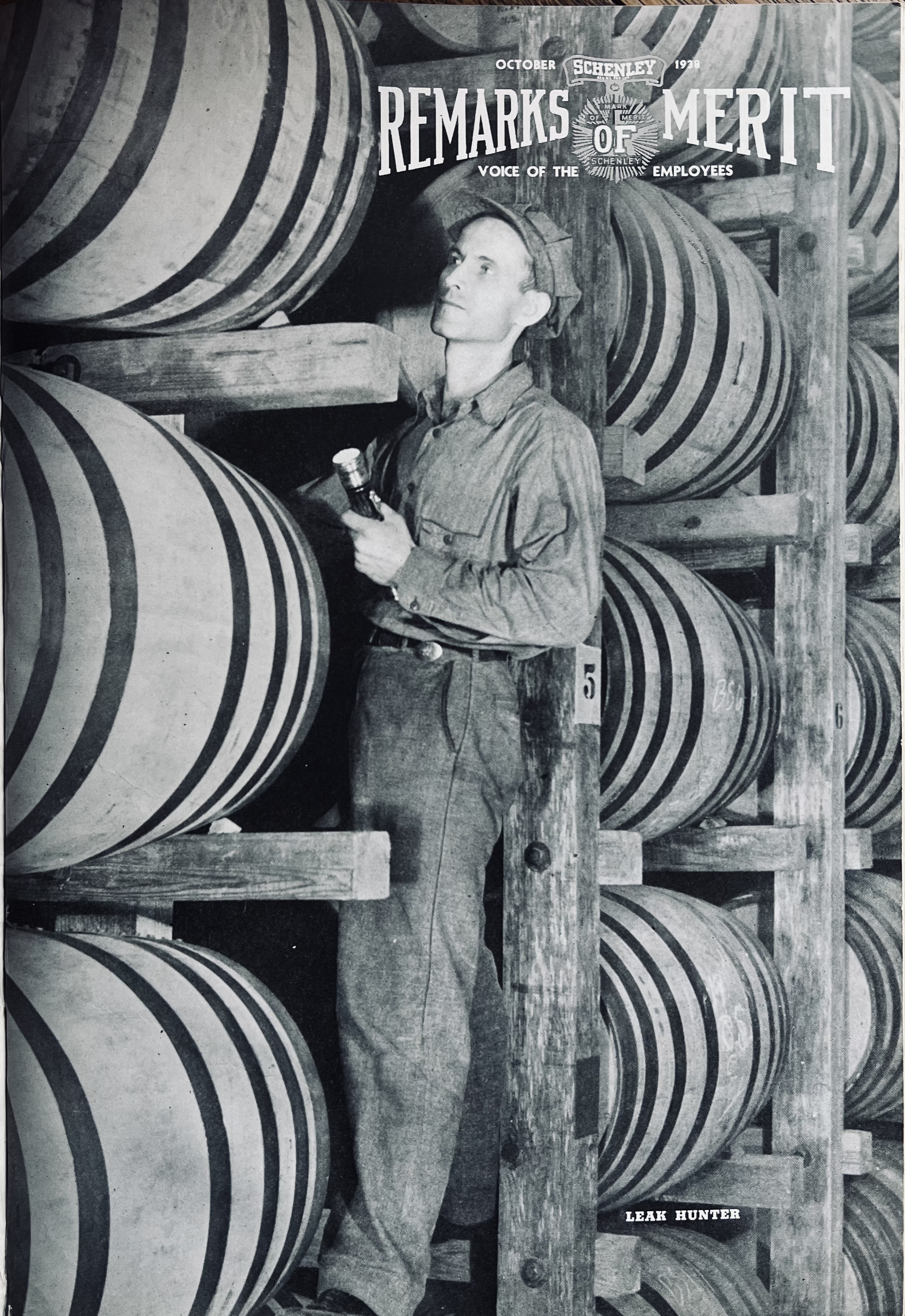
This image is from the Schenley Distilleries newsletter Remarks of Merit, dated October, 1938. These newsletters are really monthly magazines published by Schenley and given out to their employees each month. They are filled with news of the company as it expanded in the 1930s, but also articles about employees – weddings, births of employee children, etc. and other activities involving the employees such as baseball and bowling leagues. This image was taken at the James E. Pepper Distillery in Lexington, Kentucky and features William Hendricks as he is searching the barrel racks for leaking barrels.
Back in the day, leak hunters played an important role in a distillery. The government was very strict on how much whiskey could be written off as the angel’s share and if a barrel lost more than the government charts said it should, you paid the tax on the full amount the barrel should have had in it. Leak hunters were employed to crawl through the warehouse with a flashlight, looking for barrels with leaks. If it was a small leak, the leak hunter would plug the leak with a small cedar plug without moving the barrel, but if the leak was substantial, he would have the barrel removed and taken to a cooper, where the whiskey was dumped in a tank, the barrel repaired and refilled.
Since 1984, when the government loosened the regulations on the distilling industry, leak hunters became a less important job. The government is now willing to tax the whiskey based upon the amount of whiskey dumped for the day rather than measuring each barrel for taxes. Losses due to leaking barrels are accepted and not taxed to the degree they were in 1938, when this photograph was taken. In today’s distilleries, with many of them using palletized storage, leak hunters could not even get to the barrels to look for leaks. Times have changed in the last century.
Photos Courtesy of Rosemary Miller / From the archives of Michael Veach


August 7, 2026 at 10:36 am
Nice to see the myriad of workers involved in the whiskey industry getting a spot in the limelight!
August 7, 2026 at 1:01 pm
Employees searching for leaks took on greater importance after the Whiskey Ring scandal of the 1870s. Prior to that, missing whisky was assumed to be the result of leakage and evaporation—not tax evasion.